
Agenda
October 2026
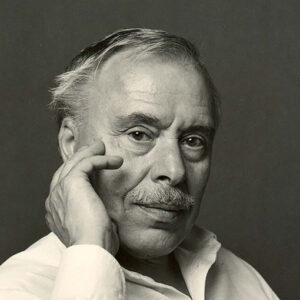
Koenig 100
Gottfried Michael Koenig (1926–2021) was one of the pioneers of electronic music. On the occasion of the centenary of his birth, the New European Ensemble presents a program centered on his fascination with structure, sound, and musical possibilities.
Koenig moved to Utrecht in 1964, where he became artistic director of the Studio for Electronic Music at Utrecht University, which later became the Institute of Sonology. Based in the Netherlands, he developed into one of the key innovators of post-war music, connecting composition, electronics, and the possibilities of the computer.
This concert presents Koenig’s work across various instrumentations: from the concentrated piano world of Klavierbuch to Variants 1 for five instruments and String Quartet 2019, one of his final instrumental compositions. Programming also features 5 Bagatellen by Konrad Böhmer, a close colleague who, like Koenig, played a vital role in the development of electronic and experimental music in the Netherlands.

The Desert Music – Steve Reich
Steve Reich’s The Desert Music is an impressive choral and orchestral work that connects poetic language with the threat and uncertainty of its time. The title and lyrics are drawn from William Carlos Williams, whose words Reich brought together into one vast, breathing soundscape, based on Williams’ collection The Desert Music and Other Poems.
There is, however, more hidden behind that landscape: Reich deliberately chose texts from Williams’ post-Hiroshima and Nagasaki period, a time when ‘the bomb’ hung like a shadow over the world. The music reveals how human dreams and desires collide with the questions raised by our conscience—a tension that forms the heart of The Desert Music. ‘The desert’ remains ambiguous: a physical place, an inner emptiness, or a vision of the future.
Led by the Hague concert hall Amare, the ensembles NKK, Klang, HIIIT, New European Ensemble, and Het Muziek join forces with the Royal Conservatoire to celebrate his 90th birthday with a performance of his magnum opus, The Desert Music.
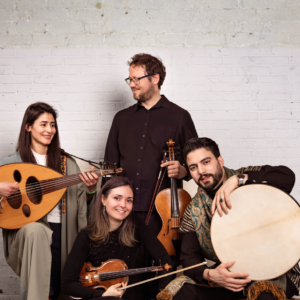
A Ticket to Aleppo
Discover the soul of Aleppo and immerse yourself in a musical journey through this ancient city. In living rooms, souks, taxis and cafés, songs of longing, resilience and desire can be heard. Spiritual voices blend with the sounds of the city, while the air is filled with the scent of coffee, pepper and cinnamon.
A Ticket to Aleppo brings together Arab and Western musicians in a warm and vibrant musical dialogue. Together, they paint a rich musical landscape of classical Arabic songs, refined maqams and exuberant improvisations. Instruments such as the oud, qanun and riq come together with violin, viola, cello and flute.
Spoken texts are in English.

Dag in de Branding
Anyone wishing to understand why Dutch music developed such a distinctive character after 1970 cannot ignore The Hague. The Hague School emerged around the Royal Conservatoire: composers who rebelled against the established music scene with its red velvet and sedate orchestras. They wrote unconventional music with a strong rhythmic drive, inspired by Stravinsky and American minimal music — and thereby attracted worldwide attention. Young composers travelled to The Hague from all corners of the globe, including Calliope Tsoupaki from Greece. She studied under Louis Andriessen and took classes in electronic music with Gilius van Bergeijk; she now teaches composition at the conservatoire herself. The pupil has become the teacher. As guest curator, she has selected three favourite pieces by the composers who have shaped her.
Louis Andriessen based his Symphony for Loose Strings (1978) on a brilliant idea: twelve string players play exclusively on loose strings, each tuned differently. No one can play a melody on their own. Each sequence of consecutive notes must travel from musician to musician. You can see and hear the music leaping from music stand to music stand. This relay technique is called ‘hoketus’ and flourished in the fourteenth century, the era of the medieval Ars Nova: the festival’s theme.
Diderik Wagenaar drew inspiration from Stravinsky, but just as much from his jazz heroes Thelonious Monk and John Coltrane. In Cat Music (1994), he portrays two cats in three pieces for two violins: in Playing, a playful melody constantly shifts in character; in Hunting, the violins chase one another in a stream of notes that never pauses for a moment; and in Purring, the two voices merge into a single contented, purring melody.
Gilius van Bergeijk is a pioneer of Dutch electronic music. In De Elementen (2024), for piano and electronics, he gives voice to earth, water, fire and air through piano sounds and sounds he recorded outdoors. He lets the wind rustle and the water flow, but his stylised nature is never unspoilt.
November 2026
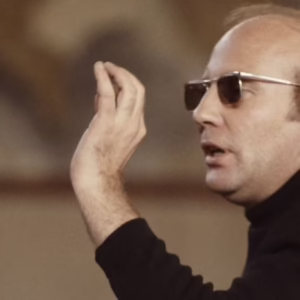
Voices – Romaeuropa Festival
Resistance is more than an act; it is a voice that demands to be heard. In the moving song cycle Voices from 1973, composer Hans Werner Henze gives the floor to twenty resistance poets from across the globe. Written in the shadow of the Vietnam War, this ninety-minute masterpiece stands as an impressive tribute to the human spirit. New European Ensemble performs this timely work under the baton of conductor Carlo Boccadoro, alongside soloists Carina Vinke (alto) and Peter Tantsits (tenor). The instrumental line-up is unique: in addition to their own instruments, the musicians collectively play about seventy different instruments from various worldwide traditions — from Africa and Asia to South America. The result is a profound soundscape that invites the listener: dare to listen, dare to discover.
Henze himself was an outsider who left Germany for Italy, fleeing both homophobia and the strict musical laws of his contemporaries. He regarded Voices as his own ‘Lied von der Erde’, concluding with a hopeful vision: a pre-Columbian flower festival dreaming of a world at peace. This autumn, New European Ensemble brings this extraordinary composition to the Romaeuropa Festival. It is a rare opportunity to experience one of Henze’s most haunting works, in which the cry for justice resonates as loudly today as it did fifty years ago.
December 2026

Pinokkio (7+)
Pinokkio begint, zoals elk kind, als een onbeschreven blad – in haar geval als een
onbeschreven blok hout. Maar zij heeft nog maar net benen gekregen of ze laat haar vader
Geppetto in de steek en loopt in zeven sloten tegelijk.
Mevrouw van der Vos, Meneer Kats en Meneer Das worden haar vrienden, en hebben
mooie, aanstekelijke verhalen. Maar kan zij deze vrienden vertrouwen? Steeds moet zij
kiezen: lol maken en lekker lui leven of verstandig zijn en hard werken? Een mooi verhaal
opdissen of de lelijke waarheid vertellen?
Van haar vrienden leert Pinokkio de voordelen van liegen tot ze inziet dat zijzelf óók in de
maling wordt genomen.
‘Is het wel waar? Doe niet zo saai!
Lieg tot alles leuker wordt, lieg alles aan elkaar
Lieg los en vast,
totdat het in je straatje past
Lieg de oren van hun kop
met bla bla bla bla bla
Lieg maar, lieg maar, lieg maar!
February 2027
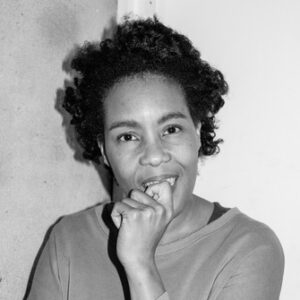
Visions
In Visions, vocalist and curator Elaine Mitchener brings together works by composers who channel the mystical, the
political, and the deeply personal. From Gubaidulina’s radiant settings of Hildegard von Bingen’s visions to Sciarrino’s
ecstatic Infinito Nero, this program explores music as revelation; spiritual, ancestral, and embodied.
Featuring voices from across cultures and generations;Raven Chacon, Julius Eastman, Njabulo Phungula, and Younghi
Pagh-Paan, Visions invites audiences into a space of radical listening, where sound becomes a form of seeing.
April 2027
Listening to the World, Cage and Frey
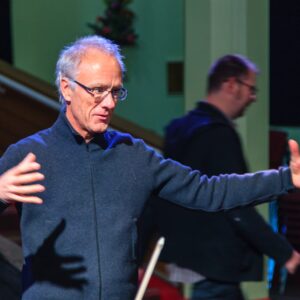
With his iconic composition 4’33”, John Cage invited listeners in 1952 to listen attentively to their surroundings and to the subtle sounds of their own heartbeat and breathing. Since then, new music has continuously challenged us to hear the world in new ways. Swiss composer Jürg Frey creates works that explore the boundaries of the audible. His compositions make use of sparse sonic material and silences, turning silence itself into the subject of the music. The result is an invitation to reflect and to experience sound in a renewed way.
A sneak peek behind the scenes: composer Jörg Frey shares more about his piece during a rehearsal with the NEuE.
Ode to Gubaidulina
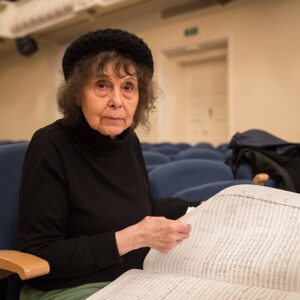
With this program, the New European Ensemble reflects on the work and legacy of Sofia Gubaidulina (1931–2025), one of the most influential composers of the past century. Throughout her long career, she developed a musical language entirely her own, where spirituality and sonic exploration come together in service of emotional power.
At the heart of the program are two works from different phases of her oeuvre. In Hommage à T.S. Eliot for soprano and ensemble, Gubaidulina responds to the poetic world of Eliot’s Four Quartets, a text she described as “an effortless bridge to music.” The work demonstrates how literature and music complement each other in exploring time, memory, and meaning.
The second work is Repentance, written for cello, double bass, and three guitars. Here, Gubaidulina explores the rich sonic possibilities of this unusual instrumentation, featuring two of her favorite instruments, guitar and double bass, in the leading roles. In doing so, she creates driving gestures in which the three guitars bring forth a surprisingly orchestral sound.
Set between these two pieces is the world premiere of a new work by American composer Michael Hersch, commissioned by the New European Ensemble for oboist Christopher Bouwman. Although Hersch has developed a musical voice entirely his own, he shares Gubaidulina’s fascination with dark, mysterious sounds and with music as a vessel for existential questions. The world premiere of this new oboe concerto places Gubaidulina’s oeuvre in dialogue with a prominent composer of today.
May 2027
Prayer & Stillness: From Bruch to Pärt and Gubaidulina
In times of uncertainty, we look for ways to give meaning to loss, hope, and change. Music can play a unique role in this: as a prayer, a ritual, or a moment of reflection.
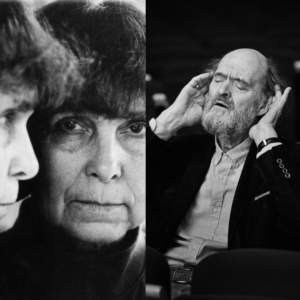
In Prayer & Stillness, the New European Ensemble presents a program where spiritual traditions and contemporary sounds meet. The concert opens with Max Bruch’s poignant Kol Nidrei, based on an ancient Jewish prayer melody. In Arvo Pärt’s famous Fratres, a musical call for brotherhood unfolds, while Djuro Živković’s intimate Psalms for Jacob features the guitar as an instrument of contemplation.
With Kate Moore’s Incantation, the program takes on a dark and intense character. The highlight of the evening is Sofia Gubaidulina’s impressive Repentance, a work for cello, double bass, and three guitars, in which profound emotional power is combined with a quest for reconciliation and inner transformation.
June 2027
Composer in residence: Carlos Simon and his Gardner Suite
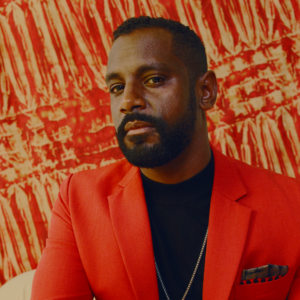
‘The best thing that can happen to me as a composer is when someone comes up to me and says they have been moved by my music,’ says composer in residence Carlos Simon. The Recital Hall will host the European premiere of his Gardner Suite: a musical museum tour inspired by works of art from the Isabella Stewart Gardner Museum in Boston. With influences from spirituals, gospel and classical music, Simon creates a unique soundscape, performed by the New European Ensemble.
Photo: Kendall Bessen